United States Navy
The Good ShepherdThe United States Navy in the novel is more than the service that places George Krause in command of an Allied convoy: it is his home, his training, and the system of rank and duty within which he understands himself. Its power depends on coordination, discipline, and material resources, yet its procedures cannot remove uncertainty or spare its people from exhaustion. Through Krause’s decisions at sea and his recollections of his formation, the institution appears as both an operational organization and the structure that has shaped a solitary life.
Identity and Wartime Role
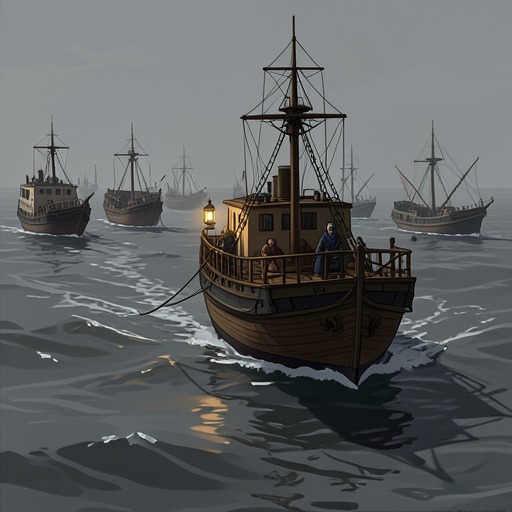
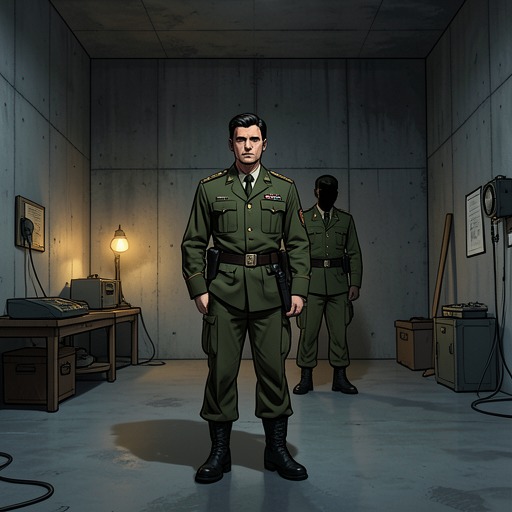
Krause is a United States Navy commander and the captain of the destroyer Keeling, a Mahan-class ship of 1,500 tons commissioned in 1938. At forty-two, he also serves as escort commander for a convoy carrying nearly 2,000 people, guarded by four destroyers and other escort vessels manned by more than 800. The figures establish the scale of the responsibility assigned to one officer, but the narrative distinguishes human stakes from balance-sheet value: the convoy includes the tanker Hendrikson, whose oil could provide an hour of steaming for the entire British Navy. The service’s work is therefore linked to a strategic need larger than the worth of any one ship or cargo.
Krause’s authority over an Allied escort also exposes the unusual circumstances in which the Navy’s command structure operates. An accident of seniority places an American officer, who has never fired a shot in anger, over younger allied captains with two and a half years of combat experience. He has rank and responsibility, but neither guarantees that his subordinates will regard his judgment as earned. The narrative makes command a test of institutional authority under coalition conditions: Krause must make decisions for the whole convoy while knowing that other officers may judge him through their own experience and expectations.
Training, Entry, and Career
Krause’s route into the Navy begins outside the service. His father, a Lutheran minister, dies when Krause is an orphan just graduating from high school as the United States enters a war. A senator nominates him to the United States Naval Academy, an appointment described as unusual because it brings the senator no political advantage and does not select the most academically suitable candidate. The nomination directs Krause’s abilities into a career he would not have chosen for himself, making institutional membership the consequence of chance as well as personal inclination.
His father leaves an estate of $300 after his books and furniture are sold. The money pays Krause’s fare to Annapolis; he can support himself thereafter on his pay as a midshipman. The class of 1922 graduates in 1921 in the aftermath of war, and Krause finishes halfway up the list. He is not singled out for general academic distinction, but discovers an above-average aptitude for fencing. Academy life adds discipline, subordination, and self-control to the moral instruction of his childhood. The narrative presents these as interacting influences: formal military discipline hardens Krause’s realism without extinguishing the Christian spirit formed at home.
Krause’s subsequent advancement is gradual. He becomes lieutenant junior grade, lieutenant, and lieutenant commander before reaching commander as the Navy expands in 1941. For seventeen years, from eighteen to thirty-five, he lives for duty. Promotion is thus both the measure of an institutional career and a source of personal vulnerability. Having been twice passed over, Krause has received the review wording fitted and retained, which the narrative describes as damning despite its apparently innocuous form. His position is not simply the reward of service: the institution retains him while withholding advancement, and he carries the judgment into his later command.
Command, Regulation, and Discipline
The Navy’s organization is shown in the chain connecting a commander’s decision to the actions of ships, officers, and individual watchstanders. When James reports a distant contact and asks permission to attack, Krause must weigh the uncertain possibility of a U-boat against the risk of thinning the convoy’s screen. Detaching one or more of only four fighting ships could leave gaps for other submarines; a prolonged high-speed search and return could consume a small reserve of fuel. Yet allowing the contact to escape could leave it free to report the convoy’s position or help summon a wolf-pack. The service’s command problem is not merely to issue an order, but to preserve the convoy’s defenses while acting on incomplete information and limited resources.
The narrative repeatedly contrasts formal readiness levels. Keeling is in Condition Two, with battle stations largely manned and watertight integrity maintained. This posture strains the crew and interferes with ordinary shipboard routine, but it can be sustained for days; General Quarters, which sends every person aboard to a battle station, can be endured only for hours. Calling it unnecessarily would interrupt sleep and meals, delay routine maintenance, and risk making men slack when repeated special demands have no evident cause. Krause refuses to sound the general alarm merely because allied ships are pursuing a distant contact. The quick decision depends on habits of prior thought, but it also expresses a command responsibility to conserve the crew’s capacity for the emergency that may actually require it.
Discipline has a different force when the commander himself is physically failing. While Keeling remains in the presence of the enemy, Navy Regulations and the Articles for the Government of the Navy make Krause’s post on the bridge an obligation he does not imagine setting aside. Charlie Cole hesitates for half a second before leaving him there, reluctant to abandon a captain with a white face, hollow cheeks, and staring eyes, but obeys the order. The scene shows naval discipline as a bond that can sustain action under pressure and as a constraint that makes even the possibility of rest or medical relief seem unavailable to Krause. His sense of duty is reinforced by rules, but exceeds the practical question of what those rules might permit.
Resources, Expertise, and Human Limits
The Navy’s effectiveness depends on finite supplies and unevenly distributed skill. During the prolonged fighting, Keeling expends more than seven tons of explosives in twenty-four hours and has only six depth charges remaining. Krause orders the ship to stop firing patterns. The cost is tactical as well as numerical: a smaller pattern covers less area, and the probability of a hit falls sharply as the number of charges is reduced. A single explosion may still unsettle a submarine, but deterrence cannot substitute indefinitely for ammunition. Each engagement uses up options that might be needed later.
Equipment is only useful through the people who interpret it. The seven lookouts scan separate sectors, repeatedly wiping spray from their binocular lenses; a submarine may show only a foot or two of periscope for less than half a minute. Their steady attention can determine whether a fleeting sighting is reported in time. Below decks, Radioman First Class Tom Ellis has spent months listening to sonar pings but has never heard an echo from a submarine. The narrative questions whether his hurried training and lack of experience will prepare him to recognize a real contact or make the rapid deductions an attack requires. The ship has instruments and trained personnel, but it also has possible single points of failure: vigilance, judgment, and practiced response cannot simply be assumed because a rating has completed a course.
Personnel arrangements further reveal the gap between the service’s demands and its capacity. Keeling has new weapons and instruments, with additional men needed to man them, but its living accommodation is already crowded. It does not have enough trained ratings to supply three watches in Condition Two, and even a hypothetical surplus of ratings would leave the ship with nowhere to sleep them or a clear means to feed them. Krause divides the company into four sections and institutes a watch-and-watch routine, aiming to give the crew as much rest as possible. He cancels routine General Quarters for a watch unless a genuine emergency arises, while most officers work four hours on and eight off. These measures do not eliminate strain; they allocate it so that readiness can continue without needlessly consuming the people on whom it depends.
Institutional Belonging and Significance
For Krause, the United States Navy becomes a substitute for the family and home he has lost. He has no living relatives, and returning to the places of his childhood does not restore his past: Oakland has changed, the Berkeley hills have been built over, and a steel bridge and traffic transform Carquinez Straits, once associated with happy memories. The familiar geography no longer offers belonging. The Navy, by contrast, has been his home for so many years that he knows no other; its steel bulkheads enclose what he recognizes as home, while the wardroom and captain’s mast stand in for family life.
That belonging is neither uncomplicated comfort nor simple institutional loyalty. The Navy gives Krause a vocation and a framework for discipline, but his identity has narrowed around duty so completely that a stalled career wounds him deeply and the prospect of leaving the bridge does not take shape in his thoughts. The service’s hierarchy can direct a life through a chance nomination, offer responsibility without full recognition, and place an inexperienced American over battle-tested allies. Its regulations organize a ship, while shortages, fatigue, and uncertain reports expose what regulations alone cannot solve. The institution’s significance lies in that tension: it is the structure that makes coordinated protection possible, and the demanding world in which the commander must preserve both the mission and the human resources on which it depends.